Tommyknocker spaceship
The TommyknockersThe Tommyknocker spaceship is the buried saucer whose presence draws Haven into a process of technological and bodily transformation. Dug out of the hillside by Bobbi Anderson and Jim Gardener, it is at once a concealed object, a source of dangerous influence, and the center of a spatial trap: the town’s borders are prepared for defense, its people are drawn toward the ship, and its eventual ascent turns an underground excavation into a spectacle of escape that does not rescue those left below.
Definition and Discovery
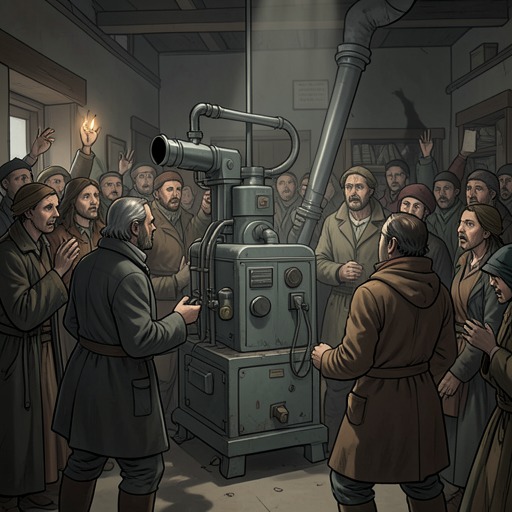
For much of the story, the ship is not a visible vessel but the object of a sustained excavation at the old Frank Garrick place. Bobbi’s rebuilt truck can be heard from Haven Village during the hot stretch of July, and residents understand that something important is happening in the woods, even as they avoid saying so aloud. The excavation is also tied to the town’s “becoming”: Justin Hurd builds a machine capable of setting up harmonic waves in the earth’s crust, with the potential to trigger a devastating earthquake. His device is intended to drive rabbits and woodchucks out of their burrows, but the mismatch between his small grievance and the scale of the danger reflects the way ordinary purposes in Haven have become entangled with destructive invention.
When Ev Hillman and Butch Dugan approach the site, the work has opened a ragged slash more than three hundred yards long and sixty feet across at its widest point. The old truck, a modified payloader with a giant screwdriver-like snout, a chainfall, a chipper, gasoline cans, and a drum of diesel make clear that this is not logging but excavation. The polished silver-gray surface draws the eye back to it: ninety feet of metal already project from the hillside, with more still buried. The ship’s scale is thus disclosed first through the altered land and the equipment required to expose it, rather than through a complete view of the craft.
Interior and Spatial Disorientation
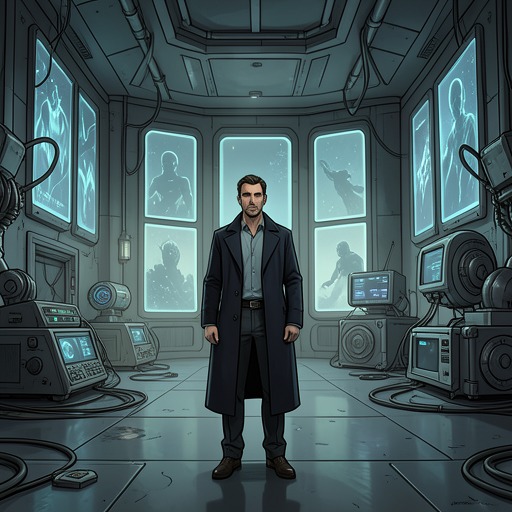
Inside, the ship’s corridor is perfectly round apart from a flat walkway running halfway up one side. Its orientation seems wrong until Gardener recognizes that the vessel itself is canted; the passage and walkway are tilted because the ship lies at an angle. Soft light glows from featureless walls, offering visibility without familiar architecture. The interior makes the ship’s buried position legible in the body: even a corridor cannot be understood by ordinary assumptions about level floors and upright walls.
The same disorientation extends beyond the hull. Ruth McCausland’s attempt to leave Haven is thwarted by an invisible barrier that makes the air feel springy and increasingly difficult to push through. She experiences pressure against her face and body, then loses ground as the barrier’s elastic force exceeds her forward motion. The ship’s influence is therefore associated not only with a destination beneath the woods, but with boundaries that regulate movement through the surrounding landscape. Haven becomes a place one can perceive and attempt to cross, yet cannot simply leave.
The Ship and the Becoming
The ship is embedded in a reciprocal system linking vessel and inhabitants. Gardener considers whether the “becoming” might be an open system in which the ship feeds humans, causing them to change, while humans in turn feed the ship and enable its return. He treats this as a hypothesis rather than settled knowledge, but the possibility gives the ship’s relation to Haven its disturbing logic: the inhabitants are not merely exposed to an alien object; they may be part of the mechanism by which it operates. His speculation that the process could begin again makes the craft’s buried condition feel less like an ending than a dormant stage in a cycle.
The people transformed by the process build machines they often do not understand. Some devices are hidden away when they prove useless to daily life; others are carried to the town’s edges and arranged as defenses. The gadgets include a machine that killed John Leandro, a brush-trimmer that attacked Lester Moran, televisions that shoot fire, airborne smoke detectors that emit lethal ultrasonic waves, and force barriers. Mentally activated with simple electronic devices known as “Callers,” these inventions form a rough perimeter around Haven. Their placement is instinctive rather than consciously planned: when the borders must be sealed, the devices are already there. The ship’s influence has thus extended from the excavation into the town’s technology and spatial organization.
Escape from the Earth
As the ship begins to move, the trench walls seem to shift and the silvery mesh slips past. The movement is not the mesh’s: the vessel is pulling itself free of the bedrock that has held it for so long. A klaxon sounds, the hull shudders and squeals, and the ship rises through smoke and hazy sunlight. The widening trench makes the vessel appear first as an immense wall or mountain, until its circular form becomes visible from the edge of the clearing. The prose’s delayed recognition mirrors the characters’ predicament: the familiar categories of landscape fail before the scale of the moving object.
The saucer cuts the trench wider as it emerges, its leading edge shearing off the tallest spruce. Once clear of the ground, it levels out, crushing trees and moving above the burning woods with slow, ponderous elegance. It hovers as if waiting, then rises straight into the air without tilting. Smoke blurs its hard metallic outline until the craft disappears. Its departure leaves the clearing, trench, and exhausted Tommyknockers behind; the trench is likened to a black socket from which a poisonous fang has been pulled. The ship escapes, but the people and place it has altered do not escape with it.
Significance
The vessel’s movement gives physical form to the novel’s central shift from concealment to exposure. At first, the ship is a hidden mass under a Maine hillside, known indirectly through noise, excavation, strange inventions, and the changed behavior of the town. Its emergence turns that concealed pressure into an immense event that reshapes the earth and the forest in full view. The ship’s passage from underground to sky is both release and abandonment: it frees itself from the bedrock, while leaving Haven’s transformed inhabitants among fire, smoke, and the wreckage of their own creations.
The spaceship is also a machine whose builders and users do not fully understand what it does. Gardener’s grim description of its makers as beings who operated machinery without trying to comprehend it exposes the danger of construction detached from understanding. The ship’s possible human-machine cycle intensifies that danger: people may serve as material for the vessel’s return even as they believe themselves to be its operators. Its final ascent offers the image of escape, but not a reassuring resolution. The object leaves the ground; the consequences of its presence remain.